Home » Headline, Paranormal

Professor French: Waking Nightmare Of Sleep Paralysis

Submitted by Javier Ortega on October 6, 2009 – 5:45 PM12 Comments | 574 views


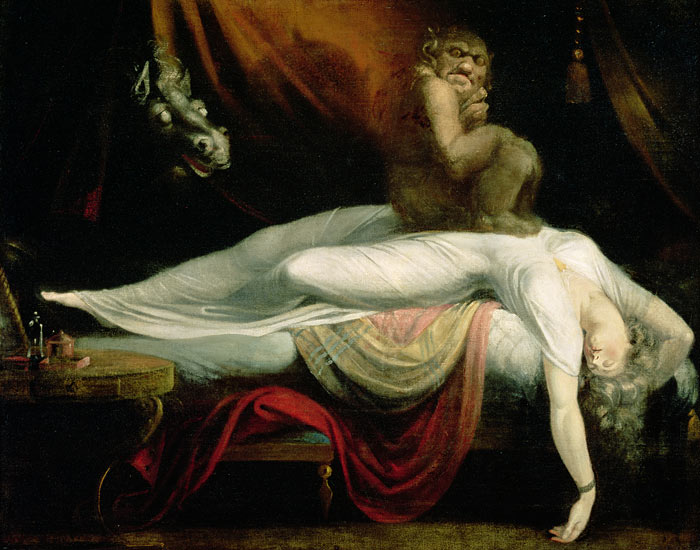
"The Nightmare" by Henry Fuseli

"The Nightmare" by Henry Fuseli


Hypnagogia is the usual explanation for ‘Sleep Paralysis’ or commonly known as the “Old Hag” syndrome. I think I’ve only experienced this once, and it is not a good feeling.

In this article, Professor Chris French recounts some heavy experiences of sleep paralysis by people. Some of which include visions of goblin-like beings, fairies and zombie-like cats. All the while the subject is in full paralysis and unable to move.

Like I mentioned in previous articles, this does explain a lot of the ‘waking terrors’ as well as alien abduction cases to some degree, but this in itself is a very vague explanation.

“The light had been switched off, and a comfortable feeling of warmth and heaviness marked the onset of sleep. But suddenly a slurping sound startled the sleeper. Everything seemed completely normal – until he noticed the green liana which had grown from the pot plant and reached his body.

“Every movement became impossible, and every scream was smothered by the plant material that was growing around his mouth and throat. Thoughts raced through the mind: This wasn’t a nightmare, the reality of the room was far too distinct and his perception and thinking were far too clear. Were the plants taking revenge on humankind, or had aliens conquered the planet?”

The above account sounds like a scene from a bad horror movie. But it isn’t. Dr Stephan Matthiesen, a physicist at the School of Geosciences, University of Edinburgh, sent me the account last year saying he had personally experienced this terrifying scenario and lived to tell the tale. It’s taken from his book The Normality of Altered States of Consciousness.

Dr Matthiesen is a scientist and looked for a rational explanation of what had happened. He was right do so, because what he had experienced was an example of a surprisingly common phenomenon known as sleep paralysis. Many similar experiences have been reported to the Anomalistic Psychology Research Unit I coordinate at Goldsmiths, University of London.

One of our students, Peter Moore, used to suffer from sleep paralysis on a regular basis. One night, for example, he awoke to find himself unable to move and with a strong feeling of tension across his chest, making it almost impossible to breathe. He could see his bedroom and managed to tilt his head, only to see an evil-looking black cat sitting there hissing at him.

Chris French is a professor of psychology at Goldsmiths, University of London, and heads the Anomalistic Psychology Research Unit.

Chris French is a professor of psychology at Goldsmiths, University of London, and heads the Anomalistic Psychology Research Unit.

But what was most terrifying about this vision was that the cat’s white skull was inverted and dripping some sort of black goo. By a huge effort of will, he finally managed to break out of his paralysed state with the intention of attacking his visitor, only to find himself delivering a right hook to thin air.

Jeremy Deane, a fellow student at Goldsmiths still suffers regular attacks of sleep paralysis, particularly if his usual sleep pattern has been disrupted. As is often reported, he can experience multiple episodes in a single night. His experiences typically involve paralysis, difficulty breathing, strange proprioceptive hallucinations such as his body vibrating, and bizarre “hyper-real” visual hallucinations during which objects may metamorphose into nightmarish objects.

For example, clothes lying on the floor may become dead bodies or a ceiling fan might turn into a “faery” with the blades as wings and the central bulb as an animate, speaking face. In his own words: “The experience is usually terrifying, but I have been able to control it and sometimes it has been very pleasant (occasionally there can be a sexual element, or ‘floating’ feelings accompanying what appears to be an out-of-body experience).

“Common images are bearded, goblin-like demons laughing or whispering sinister speech, a faceless girl (usually covering her face with hair, moving around in bed moaning and feeling my body), hands appearing from the wall and attempting to strangle me. A hung man talking in the corner of the room, and some of the most bizarre experiences may include up to a dozen ‘critter’ entities (think Gremlins movie) laughing and talking about me. The environment tends to feel like a holographic dollhouse, the experience peaks and then the hallucinations mysteriously vanish when I regain control of my body.”

There are numerous descriptions of sleep paralysis in works of fiction, from Herman Melville’s Moby Dick to accounts by F. Scott Fitzgerald and Ernest Hemingway. There are also the classic artistic depictions painted by Henry Fuseli in the late 18th century.

Not surprisingly, episodes of sleep paralysis are often interpreted by the sufferer in paranormal terms, but sleep researchers have provided a more convincing account.

During normal sleep, the brain and body pass through four stages of sleep during which physiological indices such as brain activity, heart rate and breathing rate gradually slow down. This process then reverses and the sleeper enters a period of REM-stage sleep, so-called because of the characteristic rapid eye movements that are associated with it.

The full cycle, which takes about 90-100 minutes, is then repeated and, as the night progresses, each cycle becomes progressively less dominated by stage 3 and stage 4 sleep and increasingly dominated by REM sleep. Dreams can occur during all sleep stages but the most vivid dreams tend to be reported when people are awoken from REM sleep.

Throughout these REM periods the muscles of the body are paralysed, presumably to prevent the dreamer from acting out the dream. During sleep paralysis episodes, however, something goes awry with the normal process and the individual becomes aware of the fact that they cannot move. This can be scary enough, but in a minority of cases, such as those described above, this curious mix of normal wakeful consciousness and dream consciousness can result in bizarre and often terrifying hallucinations.

Our own research confirms the results of previous surveys in showing that sleep paralysis in its most basic form is surprisingly common. Although sleep paralysis is a common symptom of narcolepsy (a condition characterised by uncontrollable bouts of deep sleep), around 40% of the rest of the population report that they have had the experience.

Around one in 20 people report experiencing associated symptoms, including a strong sense of a presence, difficulty breathing due to pressure on the chest, intense fear, and a wide range of hallucinations. These can be visual (lights or dark shadows moving around the room, monstrous figures), auditory (voices, footsteps, mechanical sounds), tactile (feeling that one is being touched or dragged off the bed or that the bedclothes are being pulled off), and/or proprioceptive (body or limbs vibrating, rapid acceleration of the whole body, out-of-body experiences).

Fortunately, most people never experience sleep paralysis, and of those that do, most only experience it once or twice in their lives, usually in its most basic form. Furthermore, most people in modern Western societies, although somewhat shaken by the experience, just shrug it off as some kind of nightmare. But a small minority assume that either the events they experienced were real, or else they are losing their sanity.

If you are one of those people, possibly suffering in silence because of fear of being ridiculed or even being treated for a psychiatric disorder, please be reassured. You are not the victim of nocturnal attack by spirits or attempted abduction by aliens. Neither are you at greater risk than the general population of serious psychopathology.

Although most people do not opt for a paranormal interpretation, the experience is so common it only requires a small percentage of sufferers to do so to account for the very large number of claimed paranormal encounters.

Sufferers can be just as terrified by the experience even if the episode does not involve any ostensibly paranormal content, sometimes experiencing their unwanted intruder as a burglar, a murderer or a rapist. Even sufferers who are well-informed about sleep paralysis and do not experience the more florid symptoms described above still experience intense fear unlike anything they experience in waking life.

This strongly suggests that the fear is not a consequence of the experience but an integral part of it, possibly caused by over-activation of the amygdala, the part of the brain that is responsible for fear.

This is illustrated by an account from Lori Ball, a healthy 53-year-old woman from Ohio who is not only well-informed about sleep paralysis but is actually cognisant of what is happening to her while it’s happening: “I try to scream (though I have great difficulty making any sound), attempt to flail around, anything, to get the attention of my husband. It is a feeling of panic, entrapment and desperation so horrifying that I have difficulty describing its magnitude.

“If my spouse notices my discomfort and responds, in my mind it’s never soon enough. One cannot simply tell me to ‘wake up’ and tap me on the arm. Often I need to be shaken somewhat to be fully present. At that point I wouldn’t care if he slapped me hard as the terror of being in that paralysed state, totally helpless, is overwhelming. Knowing that it will end eventually is of no comfort. Every second is hell.”

One of the most fascinating aspects of sleep paralysis for me is the different ways that the same core experience is interpreted across different cultures. Accounts from Europe in the Middle Ages indicate that sleep paralysis episodes were often interpreted in terms of nocturnal visits by witches or sex-crazed demons.

Even today, many societies interpret such experiences in supernatural terms based upon folklore. In Newfoundland, belief in the “Old Hag” who sits on the sleeper’s chest and suffocates them is common. The Japanese speak of kanashibari, a type of nocturnal spiritual attack.

In St Lucia, the same core experience is explained as the souls of unbaptised children who crawl on to the sleeper’s chest and throttle them.

Over the summer, I visited Taiwan to set up a cross-cultural study of sleep paralysis with colleagues at Kaohsiung Medical University. In China and Taiwan, sleep paralysis attacks are often referred to as “ghost oppression” and levels of supernatural belief are very high among the Taiwanese population.

In our study, we are interested not only in the degree to which such high levels of belief affect the tendency to interpret the experience in supernatural terms but also the degree to which pre-existing belief systems can affect the content of the hallucinations themselves. Sleep paralysis offers an almost unique opportunity to study the reciprocal interaction between biology and culture.

It seems likely that the core experience has itself played a role in the development of belief systems relating to the spirit world in many cultures and that those very belief systems, once elaborated upon, are then capable of influencing the hallucinatory content of sleep paralysis episodes in subsequent generations.

Chris French is a professor of psychology at Goldsmiths where he heads the Anomalistic Psychology Research Unit. He talks about sleep paralysis on The One Show tonight on BBC1 at 7pm

Full source: Guardian UK


Written by Javier Ortega - javier@ghosttheory.com
Get GhostTheory updates faster! sign up to our RSS Feeds or
add us on Twitter

12 Comments »

  • jbondo says:

    IMO 99.9% of all unexplained, paranormal, alien abduction, etc.. that originates with the experiencer in bed can be attributed to sleep paralysis, night terrors or one of the many variants associated with sleep.

    As for that .1%, maybe Chip Coffey can tell us.

  • redngreen says:

    Maybe, and this is a big maybe here, maybe these hallucinations and experiences are real but in order for us to see them, require our minds to be in a semiconscious state.

    More than likely not, but it’s fun to push the limits of reality :)

    I’ve always kind of had a personal theory on paranormal experiences visually manifesting most when our minds are distracted and occupied with something else. It just seems when people see things, their mind is usualy somewhere else completely. But when they look for that visual proof- rarely do they see it. I didn’t say never, just rarely.

  • jbondo,

    I wouldn’t say that it is that high of a number. (unless you were being sarcastic)

    For example, there are several people I know that tell me that they live in a “haunted house”. They wake up and see a tall dark humanoid shadow standing at the foot of their bed. At times, even the sex of the “entity” can be figured out by its details.

    These accounts do not include state of paralysis. Although one can argue that Hypnagogia includes hallucinations therefore explaining the “entity”.

    Sleep paralysis is a really odd neurological phenomenon.

    -Javier

  • redngreen,

    I think you’re in the right track.

    Most sightings happen when people are focused on other things. This is why you get a lot of “I saw it on the corner of my eye” reports.

    Maybe this also has a lot to do with the fact that infants/toddlers are more likely to see ghosts than…say adults with a fully occupied mind.

    Check this out:

    http://www.ghosttheory.com/2008/07/21/ghosts-and-children

    -Javier

  • redngreen says:

    Javier,

    GREAT link- thanks for sharing! I too have thought about the connection between children being able to see things and our distracted minds.

    When I was about 7 years old, my brothers and I were spending the night with grandparents. When I walked into the bedroom to go to bed, there in front of me was a woman with shoulder length brown hair, cut in a bob. She had on a baby blue track suit with 2 white stripes up the sides. I remember leaning in a little to make sure that, yes, I COULD actually seeing the paneling right through her. I ran back down the hall and told papa there was a woman in the room. He giggled and did his duty and checked the room but of course she was gone by then. I don’t remember being particularly scared though. I slept in that room that night. And later lived with them one summer during college, using that room. Haven’t seen anything since. *sigh*

    - Desi

  • Martin says:

    Nice article, and even better link to the other one!

    I do believe that there is more to this world than we dare to accept, or fear to accept the possibilities of some of commonly accepted as “imaginary” entities being real.

    I do agree that, whether its in state of paralysis, or just having a normal sleep, our imagination runs free, sometimes much more free than we ever wanted it to, creating all sorts of scenarios within our mind.

    Myself, I can’t comment really, I’m 25 now, and I’m yet to remember a dream, any dream, for me whole night is just a pitch black nothing from the moment I’ve fallen asleep to the second I wake up, have no recollection of a single dream, all I feel in the morning is a sense of the time that’s passed. I do though get the “falling” feeling moments and shock awakenings at night once every blue moon. But – there are people who not only remember their dreams, but dream so vividly that sometimes think given scene that’s played out in their head was actually real.

    On the other hand, what if, its a big IF but nevertheless, what if – in that semi concious, half “here” half “there” state of mind we do actually have perception of things that we’d never spot otherwise? A childs mind, not even going into different states of chemical structure of the brain between a child and an adult which may affect things, is what I’d call “pure” – kids have faith in anything and everything, they trust everything they see and they take everything they notice as real right here right now, they haven’t gone through 10, 12, 15years of educational system correcting them and telling them how to think, what is real, what “cannot” be real, whats true and whats false, they don’t try to categorise things they see or feel “by the book” attempting to segregate it on one of the known science shelves.

    They just believe and accept – much like our adult minds do when our consciousness takes some time off. So one might dare to ask, how many of the hallucinations are just imagination at play, and if any, how many are that something else.

    If you try to recall, because I’m sure everyone saw it at least once, just try to remember your family or friends having new baby, a toddler, at 1st it stares at everything with equally startled and curious look, when they get bit older it takes something new to evoke that look, how many times have you seen little babies glancing every few moments, or down right staring all the time, at… a blank wall, an empty corridor with plan nothing in it, yet even when distracted by something else, they look back at the spot until mother comes over and picks it up. Babies need stimulation to keep them interested in literally anything, they don’t just stare at your walls admiring the consistency of the paint!

    Whether its an educated reasoning, or just a way of adulthood we do lose most of perception in areas others than the physical senses, who knows, state of paralysis is a dream, but maybe not all of it ;)

  • Martin,

    Thanks for sharing your thoughts on this.

    I can’t think of a more eloquent way on putting it.

    I do believe that as the human body matures, we start losing the non-physical perception way of looking at things. Conditioning in the world (especially modern day) is far more distracting and intense than it was centuries ago. But a babies perception seems to be just that, “pure”. At least for a few months.

    -Javier

  • redngreen says:

    Martin! You said what I was trying to convey so perfectly!

    And by the way, I envy your ability to sleep without dreams. Sometimes I have such vivid, active dreams all night that I feel exhausted the next day.

  • Gary says:

    Martin, you mention no dreams, I’m lucky enough not have nightmares. I couldn’t tell you the last time I had a bonafide nightmare, but it’s been well past ten or fifteen years. It makes me wonder if the chemical producing centers of our brains are not all ‘even’ per se (on a person to person comparison). This being why people constantly have night terrors to someone like me who doesn’t have nightmares, or someone like Martin who doesn’t have (memorable) dreams.

    I still think there is something to the sleep paralysis theory as presented in this article, for sure. But I also have to consider points against it. I find it curious from reading some of the accounts of sleep paralysis of how many people claim tactile (touch) observations. They don’t account for how people do not have tactile sensory in dreams. IT’s a simple observation really. If you are dreaming and your body is paralyzed, you shouldn’t feel touch as you should. Why would you sense touch in sleep paralysis? Just a thought.

    Why is it people have the same ‘vision’ or entity plagueing them over and over again? Dreams are meant to flow in all directions, as I’m sure nightmares do (I can’t recall for my part). Shouldn’t sleep paralysis victims have a multitude of visions that assault them? I mean I can understand reoccurances, but constantly?

  • Martin says:

    Hello again :)

    redngreen – thanks ^_^! I have my moments ;) . Well I don’t know is not remembering the dreams all that great, I’d love to have a good nightmare once in a while ;P hehe I know I know, wish for one, regret asking for it later scenario.

    Gary – I did wonder about it as well, how come some remember vaguely, some perfectly, while some others just don’t recall any of the dreams. I do have rich, vivid imagination so I’d imagine whatever is that I see would be pretty weird twilight zone stuff, only yea, its a blank.

    To be exact, there are SOME flashbacks that I may recall once every odd while, but its like a 1 second moment playing out, making no sense or connection to anything, usually followed after sudden awakening related to “the falling feeling”, or what I’m more likely to have is when alarm went off, I get woken up really early but don’t have to get up yet (yes I’m a snoozer :P ) so I just lie in bed, half here, half still asleep, that’s when I can sort off see some visions playing out, but its not quite a dream since I’m conscious and have full imaginary control over what I see, meaning its more like my imagination playing out in my half asleep state, not an actual proper dream where I can’t just wish things in or out of it.

    With what you’ve mentioned about the touch, that can still be explained in the Matrix kind of way – “you think it’s air you’re breathing?” – the body itself is (supposed to be) paralysed, but if your brain is being stimulated in right way, it may feel touch, heat, pain, everything what we can feel in the real world, in the end of things its only an interpretation of electrical impulse, coming from real touch is just sparked by the dream.

    What I’m with you on in 100% is the second thing you’ve mentioned – sure, its a dream, imaginary stuff and all that, and I’m sure some people have read it in the article, a book, some magazine, maybe saw it on tv or heard in a conversation, about the goblin, old hag, ghost cat or talking hang man – which might have influenced their visions while in a dream state.
    But that covers only the percentage of people that had some sort of contact with some information about it, and that usually requires an interest in such topic to even begin researching it or talking about it, that would be a small percentage of all the people suffering similar experiences.

    Yet reports of the visions which have in many cases striking resemblance come from people of all sorts of backgrounds, interests, beliefs, nationalities, most of them when it happens to them for the 1st time – never even aware of a record of such happenings! They couldn’t have been influenced by information about something – they are completely unaware of existing out there… now THAT is something that makes you wonder :)

  • jbondo says:

    Javier,

    I don’t attribute all to sleep paralysis. I have a friend who works in a sleep study lab and he’s seen many, many instances where the subject claims to experience something paranormal (in detail) and swears they were wide awake when in fact they were asleep the entire time. He’s seen people sit up in bed, walk around the room, etc…all while asleep. Many times dreams manifest themselves to the point where it seems to be a real occurrence. Again this is just one other example of what can happen.

    There are a many different psychological things that can be happening during sleep periods.

  • Martimus says:

    While I cannot speak for anyone but myself I’ve experienced what is described as “sleep paralysis”. While this phenomenon has not happened frequently in my life it leaves a quite lasting impression. In my case the best way I can describe it is that it felt like I was being held to my bed with an invisible 10000 pound weight. I felt completely pinned down to my bed and was unable to move for what seemed 5 or 10 minutes (probably 1 or 2). My sleep paralysis seems to most frequently manifest itself as a feeling of paranoia and a total inability to move.

    I’ve read where researchers attribute this to dreams somehow gone awry. While I understand their theories I don’t think that I believe them to be true.

    What I believe is that dreams are the unconscious minds way of processing data. For me most dreams are a whirlwind of thoughts, visions, sensations, and sounds. They typically move so fast and without purpose that it’s impossible for me to remember them. Nightmares, on the other hand, have somewhat more focus. There is a common thread that the dream follows (albeit with a lot of extraneous stuff seemingly added). For me nightmares usually hang around in my mind for minutes and sometimes hours after I awake from my dream state.

    I’ve also experienced a third type of dream. One, I believe, that’s infinitely more controversial. I’ve had dreams where I found myself either in conversation with, or in situations with, my deceased relatives. Never once are words spoken in the dreams. Communication seems to be predominently symbolism and sometimes telepathic (for lack of a better way of describing it). What’s odd about these dreams is that I can remember them minutes, hours, days, weeks, and months after they took place. Several years ago I lost both my little brother and my father. Shortly after my father’s death I started having these dreams. To this day I can describe each of these dreams in bold and vivid detail.

    In the first dream my father sat in a big convertible car with the top down. I walked beside the car and we communicated without ever speaking a word. In the second dream I was taken to a house resembling one that I lived in as a child. The house was covered with foliage and I was drawn to the rear of the house (which remembled a maze of fences, bushes, swimming pools, and other obstacles). Next was a dream with my little brother and I walking out of a barn and seeing a stationary tornado just beyond the door.

    Now maybe I’m a hopeless romantic wanting to bring my family members back but that those dreams are, somehow, different. Is it possible that deceased family members speak to me through my dreams (coincidently when my guard is down, much of my mind is at rest, and when I’m not blinded by conventional wisdom)? I don’t know if my experiences are live or memorex. The truth is that it’s comforting to think that they’re still around.

Leave a comment!

Add your comment below, or trackback from your own site. You can also subscribe to these comments via RSS.

Be nice. Keep it clean. Stay on topic. No spam.

You can use these tags:
<a href="" title=""> <abbr title=""> <acronym title=""> <b> <blockquote cite=""> <cite> <code> <del datetime=""> <em> <i> <q cite=""> <strike> <strong>

This is a Gravatar-enabled weblog. To get your own globally-recognized-avatar, please register at Gravatar.